
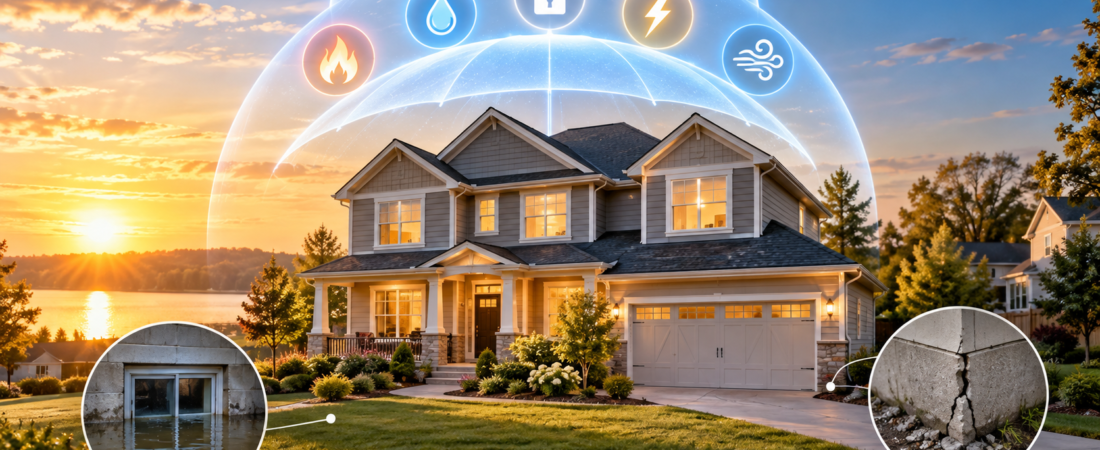
Quick Answer — It depends: Homeowners insurance typically pays for sudden, accidental damage to the house, other structures on the property and your belongings. It also usually includes liability protection and help with extra living costs after a covered loss. What your policy actually pays depends on the cause of damage, your limits, your deductible, any endorsements and your state.
A homeowners policy isn’t a maintenance plan for your house. It’s protection against certain kinds of sudden, costly trouble. Standard policies typically cover the structure of your home, other buildings on your property, your belongings, your liability if someone gets hurt, and extra living costs when a covered loss makes the home unlivable. This guide explains what’s usually covered, what’s commonly left out, why the cause of damage matters so much, and how to check your own policy.
What Does Homeowners Insurance Cover on the House Itself?
The core of a standard policy is dwelling coverage, the part that pays to repair or rebuild the house itself after a covered loss. That typically means the walls, roof, floors and permanent features, along with attached parts such as an attached garage. Many policies also include “other structures” coverage for buildings on your property that aren’t attached to the house, such as a detached garage, a shed or a fence.
Whether a particular cause of damage is covered depends on how your policy is written. Some policies cover damage from any cause unless it’s specifically excluded, which is often called “open perils” coverage. Others cover only the causes they list by name, known as “named perils,” and the approach can differ between the house and your belongings, so your own wording matters.
The photo gives a close-up look at part of a home, the kind of structure dwelling coverage is meant to protect.
Does Homeowners Insurance Cover Your Belongings, Liability and Living Costs?
Your belongings, such as furniture, clothing and electronics, are typically covered for the causes of loss your policy lists, often with special limits for items like jewelry or collectibles. Payment may be based on replacement cost, which is what it takes to buy a similar new item, or actual cash value, which subtracts depreciation for age and wear. A renters policy works differently on one point: it typically covers the tenant’s belongings, liability and loss of use, but not the building, which is usually the landlord’s responsibility.
Liability coverage typically helps if someone is injured on your property, or if you accidentally damage someone else’s property, and it may help with legal defense costs as well. Many policies also include a smaller medical payments feature for minor injuries to guests. Loss of use, sometimes called additional living expenses, typically helps with costs like temporary lodging when a covered loss makes your home unlivable, though the details depend on the cause of the loss and your limits.
What Does Homeowners Insurance Typically Exclude?
Insurers tend to exclude losses that are widespread, predictable or preventable. A flood or earthquake can damage many homes in one area at once, and ordinary aging is expected rather than surprising. That’s why standard policies commonly leave these out, and why coverage for some of them is often sold separately or added by an endorsement, which is a written change to the policy.
Water is where many owners get tripped up, because rain, rising water and plumbing leaks can be treated very differently. Backup of sewers or drains, for example, is often excluded unless you’ve added coverage for it. Our article Does Renters Insurance Cover Basement Flooding? looks at that flood-versus-plumbing line from a tenant’s side, and the same logic often shows up in homeowners policies.
- Flood and surface water: typically excluded from standard policies, though separate flood coverage may be available through other programs or insurers.
- Earthquake and earth movement: commonly excluded, with coverage often offered as an add-on or separate policy.
- Wear and tear and gradual damage: aging roofs, corroding pipes and slow deterioration are commonly excluded because they’re expected over time.
- Neglect: damage that results from failing to maintain the home or to protect it after a loss may be limited or denied.
- Intentional damage: losses caused on purpose by an insured person are typically excluded.
- Pests: damage from insects, rodents or similar infestations is often excluded, since it’s usually treated as a maintenance issue.
Why Does “Sudden and Accidental” Matter for a Claim?
“Sudden and accidental” generally describes damage that happens abruptly and unexpectedly, like a pipe bursting overnight or a tree limb crashing through a roof. “Gradual” damage builds up slowly, like a drip that goes on for a long time or wood that rots over the years. Insurance is designed to cover unexpected events, not the ordinary cost of owning and maintaining a house, which is why gradual damage is so often excluded.
Here’s a hypothetical example. Picture a homeowner who notices a stained ceiling: if a supply line failed suddenly, the insurer may treat it as a sudden accident, but if the inspection suggests a small leak had been dripping for a long time, part of the claim may be treated as gradual damage. The stain looks the same either way, and the outcome depends on the policy wording and the facts of the loss.
| Situation | Typically covered? | What to check in your policy |
|---|---|---|
| A pipe inside a wall bursts suddenly | The resulting damage is often covered, though fixing the failed pipe itself may be treated differently. | Water damage wording, any exclusion for repeated or continuous leakage, and your deductible. |
| A slow leak under a sink goes unnoticed for a long time | Often excluded or limited because the damage is gradual. | Exclusions for seepage over time and wording about maintenance and prompt repairs. |
| Wind tears shingles off the roof | Often covered when a covered storm causes it, while worn or aging roofs may be treated differently. | Roof-specific wording, whether wind or hail has its own deductible, and whether roofs are paid at replacement cost or actual cash value. |
What Should You Check in Your Own Homeowners Policy?
Start with the declarations page, the summary page that lists your coverages, limits and deductible. The limit is the most the insurer will pay for a given coverage, and the deductible is the amount you pay toward a covered loss before the insurer pays the rest.
Policies and rules vary by insurer and by state, and storm-related wording is a good example. Some policies handle wind, hail or named storms with different deductibles or conditions, and our article Does Renters Insurance Cover Hurricane Damage? shows how that kind of wording can play out for tenants. Your agent or insurer can explain how it applies to a home like yours.
- Find the declarations page and write down each coverage limit, including the ones for the house, other structures, belongings and liability.
- Note your deductible, and look for any separate deductible that applies to certain causes of loss, such as wind or hail.
- Read the exclusions section and the definitions slowly, since a single defined term can change what a sentence means.
- Check whether belongings and the roof are paid at replacement cost or actual cash value.
- Look for endorsements attached to your policy, and ask whether flood, earthquake or sewer backup coverage is included or available separately.
- Write down anything unclear and ask your agent or insurer to explain it in writing.
Pro-Tip: Take photos or a slow video of each room, closets and storage areas included, and keep receipts or serial numbers for bigger items. Store copies somewhere outside the house, such as cloud storage, so they survive a loss. Accurate, honest records support a claim, and updating them after major purchases or renovations keeps them useful.
When to Talk to Your Insurer, Agent or an Attorney:
- Damage keeps spreading or the home feels unsafe. Personal safety comes first with electrical, gas, fire, flood water or structural problems, so follow guidance from emergency services, your utility or a qualified professional, then contact your insurer.
- You receive a denial letter you disagree with. Ask the insurer to point to the policy language it relied on, and know that a licensed attorney in your state can advise you on your options.
- The home is a total loss or can’t be lived in. Ask how the coverages for the house, belongings and living expenses work together under your policy.
- Someone is injured on your property, or you’re accused of damaging someone else’s property. Let your insurer know early, because liability claims often have conditions about how they’re handled.
- The wording is unclear, or you’re a tenant unsure whether the landlord’s policy or yours responds to damage.
Pull out your policy this week and find two things: the exclusions section and your deductible. Jot down any exclusion that surprises you, and ask your agent or insurer whether an endorsement or separate policy exists for it.
Frequently Asked Questions
What does homeowners insurance cover?
A standard homeowners policy typically covers the structure of your home, other structures on the property such as a garage or fence, and your personal belongings. It also often includes liability protection if someone is injured on your property, and help with extra living costs if you can’t stay in your home after a covered loss. What is actually covered depends on your policy and state, so it’s worth reading your policy documents.
Does homeowners insurance cover flood damage?
Standard homeowners policies typically do not cover damage caused by flooding. Many homeowners buy a separate flood policy for that protection. Availability and terms depend on your policy, your location and your state, so ask your insurer what applies to your home.
Does homeowners insurance cover water damage from a burst pipe?
Homeowners insurance often covers water damage that is sudden and accidental, such as a pipe that bursts unexpectedly. It usually does not cover damage from slow leaks, poor maintenance or long-term wear. How your claim is treated depends on your policy and state, so check your policy wording or contact your insurer.
Does homeowners insurance cover stolen belongings away from home?
Many homeowners policies often extend some coverage to personal belongings that are stolen away from your home, such as from a car or while traveling. Limits and exclusions usually apply, and valuable items like jewelry or art may need additional coverage. The details depend on your policy and state.
What can I do if my homeowners insurance claim is denied?
A good first step is usually to read the denial letter carefully and ask your insurer to explain which part of the policy it relied on. You can often submit additional documentation or ask for a review of the decision. If you still disagree, a licensed attorney or your state insurance department can help you understand your options.
Where to Verify This for Your Own Situation
- Your own policy: the declarations page, the coverage forms and any endorsements are what actually decide a claim.
- Your insurer or licensed agent: ask for the answer in writing if it affects a major decision.
- Your state insurance department: the regulator for your state, through the National Association of Insurance Commissioners (NAIC) website.
- General consumer explanations: the Insurance Information Institute.
- Flood coverage: the National Flood Insurance Program (a separate policy from standard home or renters insurance).
Disclaimer: This article is general educational information, not insurance, legal, tax or financial advice, and it is not a statement about what your own policy covers or will pay. Coverage depends on your specific policy wording, endorsements, limits and deductibles, your insurer and your state, and on the facts and cause of each loss. Insurers decide claims based on your policy, so read it and confirm details with your insurer or a licensed insurance agent before you rely on anything here or file a claim. Covered or Excluded is not an insurance company, agent or broker, and we cannot review your policy or your claim. If you need legal advice about a denied claim, speak with a licensed attorney in your state. In an emergency, contact emergency services first.